
Perhaps, the most uncomfortable thing about minding your own peace is that you may eventually discover that you were never outside the problem.
 The other day, I was at the salon when I noticed the UV sterilizer, broken so that it exposed the combs and brushes in it.
Naturally, I started wondering, Why doesn’t this thing look like it’s working properly?
Then I laughed at myself because, even if the blue light or purple, or pink, whatever colour it was, had been on, what would that have proved? I still wouldn’t have known whether the thing was actually working.
I could have simply asked.
But I didn’t.
Because, Charlie, I’m not going to be the one to ask the question so that the hairdresser will look at me like, Where is this girl from? Why does she even care?
So I kept quiet.
I decided to mind my own peace.
There, I had already started giving myself reasons why that was perfectly fine. After all, I wasn’t going to catch any infection. And how many hairdressers in Ghana even have those sterilizer boxes sitting there in the first place? At least this one has one. Maybe I’m worrying too much.
So I left it.
Or at least, I thought I did.
Because when I got home, that small, insignificant question was still somewhere in my head.
I could have just asked.
It wasn’t even a serious question. I wasn’t accusing the woman of anything. I wasn’t saying she was doing something wrong. I just wanted to know if the thing worked but, I didn’t ask because I didn’t want to be that person who asks too many questions.
And I think that was what bothered me.
Not the sterilizer.
The fact that sometimes I would rather keep quiet than ask a perfectly reasonable question simply because I don’t want to make things uncomfortable.
Maybe it’s because I’m not very good at making serious things sound like a joke just so I can get an answer. Some people can ask you a very serious question with a smile, and somehow you don’t even feel like you’re being questioned. In my case, I’ll ask the question and suddenly everybody knows I’ve asked a question.
So sometimes, I just keep quiet.
I mind my own peace.
But lately, I’ve been wondering how much that peace is actually costing me and how much it might be costing us.
I’ve seen how I’ve allowed a lot of things to slip through my fingers: opportunities to grow, opportunities to learn, and sometimes even an opportunity to laugh, simply because I count the cost of what could go wrong and exaggerate it.
I forget that what I think could cost me, what I’m so afraid to burden myself with today, could actually cost me and others far more than we ever expected.
And I don’t want to start walking around with very skeptical eyes, questioning everything and looking weird. Because, of course, we’re in a Ghanaian society. You better not be too inquisitive.
Ask too many questions and you start looking a little too pessimistic. You might even be the one making the whole place tense because of all your questions and this need to find out what is going on.
So sometimes, keeping quiet just seems like the better option.
Mind your business. Don’t stress yourself. Let people do what they’re doing.
But I bet the Bible wasn’t referring to that kind of “mind your own business”, the kind that will eventually cost us far more than we imagined when it said, “Make it your ambition to lead a quiet life: You should mind your own business and work with your own hands.” (1 Thessalonians 4:11)
Because maybe there is a difference between minding your own business and minding only your own business.
When the verse says that we should “mind our own business and work with our own hands,” I don’t think it is telling us to become so occupied with our own lives that we stop seeing what is happening around us.
Because there is something ironic about that kind of peace.
If I decide to mind only my own business, keep quiet about certain things and leave everything else to whoever is responsible, I may feel like I am protecting myself. But eventually, whatever is happening around me will happen to me too. Whether I like it or not.
And then I realize that I have not really made myself independent. I have simply made myself dependent on a system that I never bothered to interrogate.
Dependent on the government to somehow fix the system.
Dependent on someone else to ask the uncomfortable question, demand or notice what I noticed.
And perhaps that is the part that bothers me.
Because the Bible is also clear about where our eyes are supposed to be fixed: on Jesus. And the peace He gives is not the kind of peace I manufacture by shutting my eyes to everything that makes me uncomfortable.
There is a difference between receiving peace and avoiding disturbance.
One is trust.
The other can sometimes be avoidance.
So I’ve started looking at my own life a little differently.
In what ways am I depending on the mercy of other people?
Where am I depending on a system to work without ever asking whether it actually works?
Where am I waiting for somebody else to ask the question I was afraid to ask?
And how many times have I called that “minding my own peace” when, really, I was just hoping that somebody else would deal with the problem before it reached me?
Perhaps, the most uncomfortable thing about minding your own peace is that you may eventually discover that you were never outside the problem.
You were only waiting for it to become yours.
And maybe I’ve confused the two.
Eventually, what happens when every single person decides to mind their own business for the sake of peace and outsource their responsibility?
We allow ourselves to be exploited.
And historically, we have a story of exploitation. I’m not even
too sure how it all began, but what I’m more concerned about now is how we’ve turned to exploiting each other.
And the benefits? I won’t lie, they’re great. You get things done, gain an advantage, find someone who knows someone, and get around a system that isn’t working for you.
But it is detrimental to the society we say we want to build.
And maybe if you’ve been minding your own peace for long enough, you’ve reached the point where you’ve lost hope in the society we can still build. You become resigned to it. You worry about what might happen if you speak. Tribalism, partisanship and individual survival start convincing you that nothing will change anyway.
And when we don’t do anything now, we create room for bad leadership.
So we learn to survive the system instead.
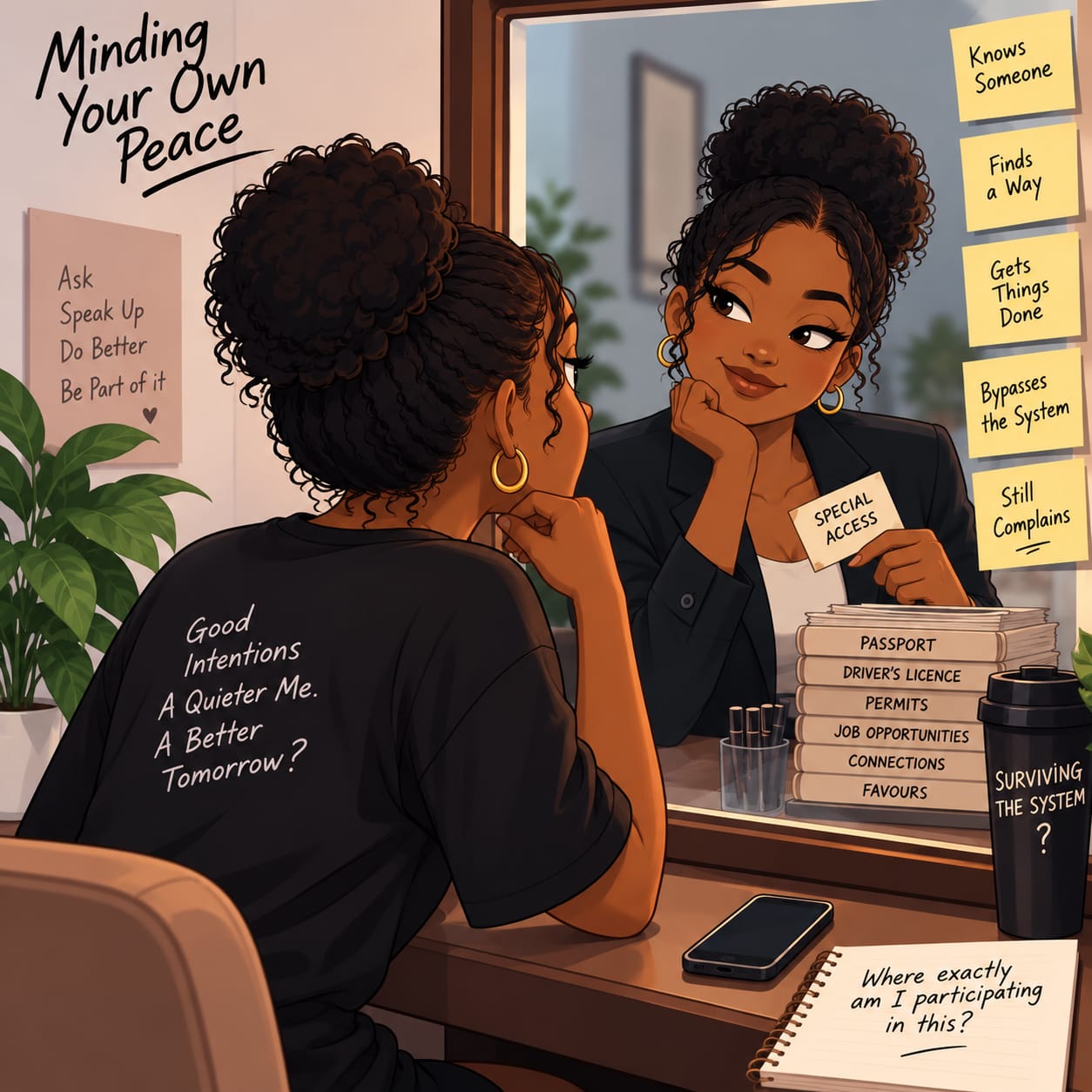
We complain about the government and everything that isn’t working, then in the evening we call a friend and ask, “Charlie, you get network for the passport office inside?”
It’s funny, too, when we tell young people to “make networks” at the university. Sometimes what we really mean is: make friends with people who can help you bypass the system when the system refuses to work for you.
And perhaps that is one of the ways we have learnt to survive.
But surviving a broken system and fixing a broken system are two very different things.
And I have done this myself.
Take the driver’s licence, for example. I’ve heard so many people say there is no way you can pass the exam without “sorting” your way through. I don’t even know how true that was. But I believed it enough to decide that I wasn’t going to put myself through the stress of finding out.
So I paid.
And I made my way through.
And there it was.
I had contributed to the very system I claim I want to change. I had complained about how things work, and then, when it was my turn, I found a way around the system instead of interrogating it.
And this is where it gets uncomfortable for me.
Because it’s very easy to talk about corruption when you’re not benefiting from it.
It’s easy to say, “The system is broken.”
But what happens when the broken system suddenly works in your favour?
Do I still want it fixed?
Or do I just want it to work for me?
Maybe that is the part of this whole thing I don’t want to admit.
Sometimes, I don’t actually want a better system. I just want a broken system to be kind to me.
And if enough of us think that way, what exactly are we changing?
This may not be what Paul meant when he wrote it. But reading those words today made me think about a different kind of dependence.
What if the price of protecting my peace is that I become part of the reason nothing changes?
And the deeper question is:
Where, exactly, am I participating in this?
Written by fellow Tracey-Lee Moulton